01
Catalog and inventory
Map SKUs, variations and listings. Coordinate prices and availability from a defined source.
Clear rules for your products.

CUSTOM SOFTWARE · BARRANQUILLA AND COLOMBIA
We build custom integrations between Mercado Libre, your ERP and online store. Coordinate listings, stock, prices, orders and shipping through authorized access and your business rules.
LESS FRICTION. MORE POSSIBILITIES.
It is software connecting enabled Mercado Libre API resources to your systems with seller authorization. It reads or updates information within granted permissions and availability. We define which system owns each field to avoid conflicting updates.
Map SKUs, variations and listings. Coordinate prices and availability from a defined source.
Import orders and map payments, packs and shipments to prepare internal operations.
Detect errors, recover pending changes and reconcile differences between systems.
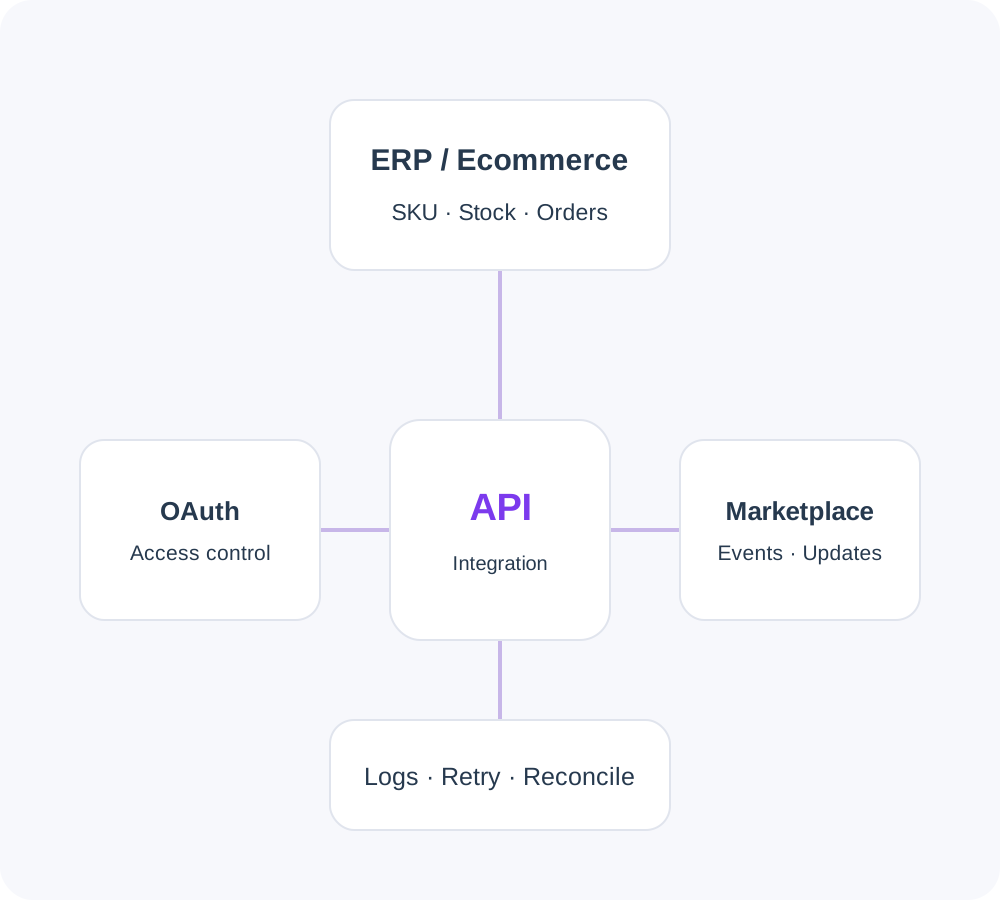
EVERY PIECE, IN PLACE
Your ERP can own inventory while Mercado Libre owns marketplace states. The integration maps identifiers, validates updates and records outcomes; it does not replace platform decisions or rules.
The seller authorizes the application; we do not request their password. Manage tokens and revocation on the server.
Agree SKU mapping, source systems, reservations, states and duplicate controls before automation.
Queues, bounded retries, alerts and reconciliation. An API failure is not treated as successful completion.
THREE CATEGORIES. DIFFERENT WORKFLOWS.
Retailers, distributors and online stores
A retail workflow connected to your stock and order rules.
Car dealers and vehicle sellers
A classified-listing workflow; product checkout and shipping do not automatically apply.
Real estate agencies and property teams
A property-listing workflow; visibility, contact fields and packages depend on category and account.
We verify MCO account permissions, eligible resources and contracted packages before scoping. Enquiries or WhatsApp clicks do not grant access to private chats or authorize unsolicited campaigns.
API CAPABILITIES, APPLIED TO YOUR OPERATION
Connect titles, descriptions, images, categories, attributes and variations to your catalog. Validate required fields and restrictions before listing updates; publication does not guarantee approval or ranking.
Map internal SKUs, listings, variations and User Products. Define inventory ownership and reservations; multi-origin accounts require compatible stock resources and locations rather than a generic quantity update.
Update prices using approved rules, currency and enabled resources. Review available fees and shipping costs to assess margins; neither profit nor instant updates are guaranteed.
Import orders and states and map packs, quantities and external references to your ERP or store. Use duplicate controls and reconciliation rather than treating every notification as a new sale.
Retrieve related shipments, tracking and status. Assess labels and enabled logistics modes. Full, Flex and other programs depend on seller eligibility, country and requirements; integration does not grant access.
Organize listing questions and replies through permitted resources. After-sales messaging has its own rules; it is not a channel for external campaigns or unauthorized reuse of buyer data.
Retrieve available authorized information for accounting workflows. DIAN electronic invoice issuance requires your invoicing provider and fiscal rules; retrieving billing information is not valid invoice issuance.
Map order payment status to internal workflows and permitted reporting. Mercado Pago checkout is a separate integration with its own permissions and terms; unrestricted financial access is not promised.
Receive enabled events, fetch updated resources and process changes with controlled retries. Keep traceability, prevent duplicates and reconcile periodically; notifications do not guarantee exactly-once delivery or failure-free sync.
Evaluate campaigns, discounts and catalog features available to your account. Resources vary by country, category and seller; Mercado Libre determines participation, eligibility and exposure.
Centralize listing notices, errors and correction requests for your team. The application cannot bypass moderation or promise reinstatement of accounts or listings.
Build a view of pending work, imported orders, stock differences and errors using authorized data. Define refresh, retention and role-based access without collecting unrelated information.
Connect your vehicle catalog or DMS to listings: attributes, photos, prices and listing lifecycle within categories and contracted packages. Route permitted questions and interested contacts to CRM. These are classifieds; product-stock, checkout and shipping workflows do not automatically apply.
Connect your property CRM to listing details, location, photos, price and states. Assess updates for sold or rented properties and permitted enquiries/leads. WhatsApp contact links or click metrics do not expose conversation content or authorize campaigns.
Event received → retrieve the authorized order → match SKU and pack → create or update the internal order → reconcile stock and shipment state. If a call fails, keep it pending and alert the responsible team. This is a proposed workflow, not a measured customer result.
TECHNOLOGY WITH PURPOSE
Assess APIs and permissions on both sides. Each connector needs version, field and limit checks; naming a platform does not imply automatic compatibility.
Siigo, Odoo, Zoho or custom systems with compatible APIs. Orders, products and tasks follow your operational model.
Shopify, WooCommerce, VTEX, Magento / Adobe Commerce, BigCommerce and custom stores: define shared catalog and stock and prevent conflicts.
Custom backend, webhooks and queues. n8n may support bounded workflows when volume and controls fit.
Private secrets, minimum permissions, token-free logs, alerts and tests using authorized accounts.
Implementation, hosting, support and third parties are quoted separately. Marketplace fees and provider charges are not included. Limits and resources may change.
FROM CHALLENGE TO PRODUCT
Start with one market, one account and one measurable workflow. Expand after validating data and failure recovery.
Review the MCO account, catalog, volume, ERP and eligible resources.
Define authorization, SKUs, priorities, states and update rules.
Test duplicate orders, stock changes, limits and revoked permissions.
Document operation, monitoring, access and agreed maintenance.
LOCAL CONTEXT. LONG-TERM VISION.
Work with retailers, distributors and ecommerce teams in Barranquilla, Atlántico and across Colombia in coordination with your team.
For Colombia, verify the MCO site, currency and available rules. Regional guides can include examples from other countries; those resources are not automatically promised for a Colombian account.
OFFICIAL DOCUMENTATION · REVIEWED NOVEMBER 2, 2026
These references describe platform resources, not proof of availability for every Colombian seller. We review the application, account and current terms before implementation. Tuimagen.Net is an independent provider and does not claim official partner or certification status.
Yes, assess classifieds-specific APIs for listings, attributes, images, packages and authorized leads. Properties and vehicles do not automatically use product inventory and checkout. Validate category, country, account and permitted data before connecting a DMS or CRM.
We can assess custom integration, also with Shopify, BigCommerce or other API-enabled systems. Define data ownership, SKUs, orders and states; Siigo invoicing needs its own rules and access. This is not an installed connector or universal synchronization.
Yes, if your ERP supports the required operations through an API or another authorized mechanism. Review data, permissions and rules before defining a custom connector.
It can reduce manual work and stock differences, but does not eliminate all risk. Reservations, latency, simultaneous sales, failures and channel rules need design and reconciliation.
Not by default. Retrieving billing details does not issue an electronic invoice. An enabled invoicing provider connection and fiscal rules are additional scope.
No. Use OAuth authorization from an eligible account with agreed permissions. Application credentials stay private and access can be revoked.
No. Marketplace operations integration is not equivalent to implementing Mercado Pago checkout. Each product needs its own resource, permission and terms review.
Assess separate authorization and seller data isolation. Markets, categories, currencies and logistics differ; copying MCO configuration is not sufficient.
We do not claim certification, affiliation or endorsement. Tuimagen.Net provides independent development; Mercado Libre owns its brand and platform decisions.
It depends on systems, accounts, volume and workflows. Quote discovery, implementation and operations by scope; no universal price, timeline, sales or ranking guarantee.
YOUR NEXT STEP
Tell us your ERP or store, seller account, product count and current manual process. Define a viable first workflow together.
Get an integration quoteOr reach out through contact