Drupal & artificial intelligence
Drupal AI: what it is, use cases and how mature it is
Reviewed:

In this article
Drupal AI integrates artificial intelligence into Drupal website workflows. It connects models with a portal’s content and tools to support writing, translation, information retrieval and automation. Its modular architecture brings these capabilities into editorial work and an organization’s digital services.
What Drupal AI is intended to solve
Drupal Core provides the content management foundation. Drupal CMS brings together tools and configuration for starting a site. Drupal AI adds a framework and an ecosystem of specialized AI modules. The Drupal AI initiative coordinates development and strategy for this ecosystem within the community.
The project connects AI with the structured content, rules and processes an organization already manages in Drupal. Its integration layer links the site to model providers and exposes operations that feature modules use for specific tasks. The model is selected through the provider configured for each function.
Inside AI and Outside AI
Inside AI brings artificial intelligence into Drupal interfaces through assistants and workflows for site teams. Outside AI supports external agents interacting with Drupal: querying content, exploring its structure and carrying out actions through tools and integrations. Together, these workstreams expand how people and applications work with the platform.
How an implementation works
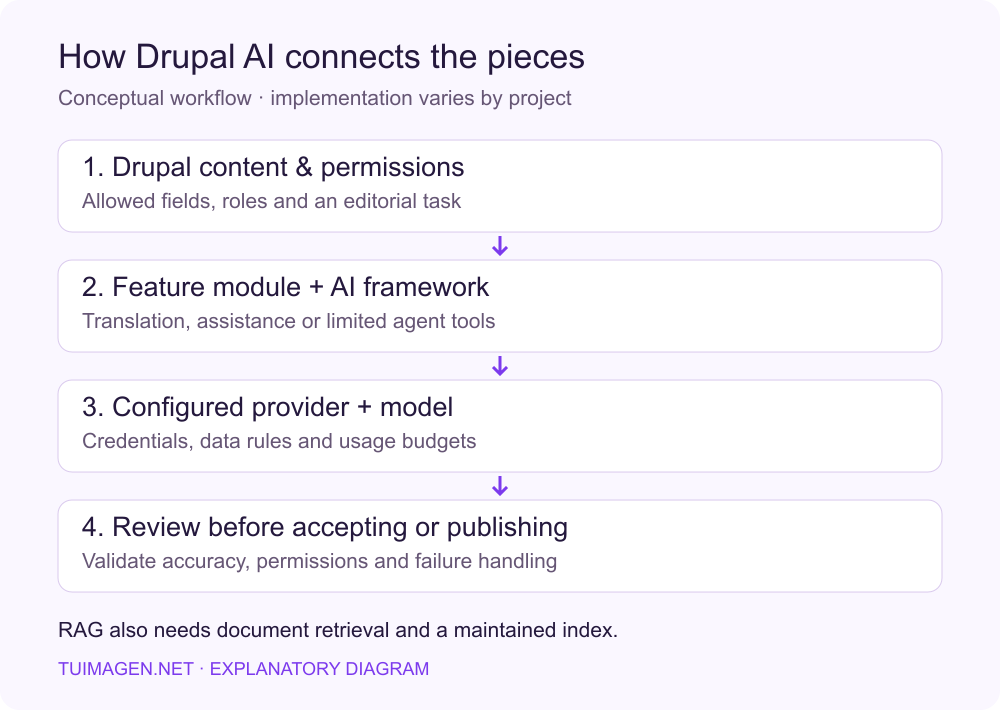
An editorial action connects to a feature module, the AI framework, a provider and a model. Results return to Drupal as a draft, a suggestion or a completed task. Document search adds an index and an information retrieval system. API integrations connect these workflows with other applications.
Configuration brings together Drupal and PHP versions, installed dependencies, provider credentials and user permissions. Composer manages the project’s packages. Each task can use its own model and instructions, according to the language, content type and intended experience.
Business use cases
Editorial assistance. Teams can generate summaries, title ideas, categories and drafts from existing material. Suggestions become part of the editor’s workflow, with results adapted to the publication’s tone and purpose. This suits portals with frequently updated catalogs, news and resources.
Translation. AI Translate is installed as an independent project and integrates with Drupal’s translatable content. It generates versions in configured languages and supports working with them as drafts. For Spanish and English portals, a shared glossary helps maintain consistent product, service and technical terminology.
Document search and answers. AI Search combines Search API, embeddings and vector databases to find content by meaning. In retrieval-augmented generation, or RAG, relevant passages are retrieved and supplied to the model as context for an answer. Document selection and index updates form part of this architecture.
Agents using tools. AI Agents defines agents that use available Drupal actions, including tasks involving fields, content types and taxonomies. Their tools and permissions determine the operations they can perform. This supports specialized assistants for administration and organization-specific workflows.
How mature is Drupal AI in October 2026?
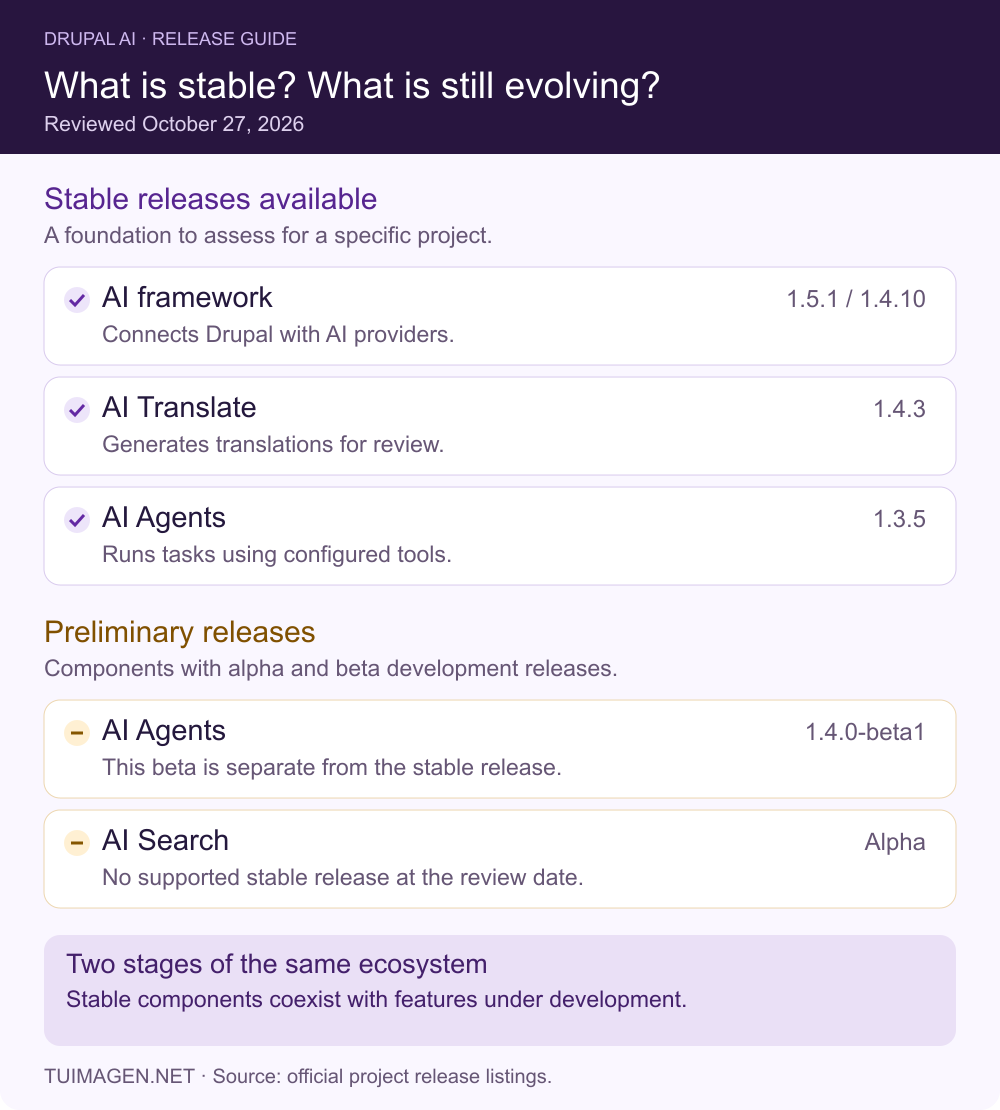
The ecosystem combines stable components with others under development. AI 1.5.1 and 1.4.10, released October 14, 2026, are listed as stable releases covered by Drupal’s security advisory program. The framework also maintains development branches for new functionality.
AI Translate 1.4.3 was released as stable on October 13. AI Agents offers stable 1.3.5 alongside beta 1.4.0-beta1, both released September 2. AI Search is in its alpha phase, and its official listing states that it does not yet have a supported stable release.
This creates two adoption paths: features built on stable components and exploratory projects using preliminary components. Editorial assistance and translation can use stable modules; search features based on AI Search represent an earlier stage in the ecosystem’s development. Component selection follows each project’s functionality and dependencies.
How data and permissions are organized
The architecture defines which content each function uses, where processing takes place and how long data is retained. A provider may run as an external service or on infrastructure managed by the organization. Drupal roles organize access to tools and available actions.
In a RAG solution, permissions also shape document selection and retrieval. Index management covers content updates, access changes and deletion. Agents receive a defined set of tools, while logs provide visibility into activity and workflow behavior.
Costs and maintenance of a Drupal AI solution
The budget covers development, configuration, model usage, embeddings, storage, hosting and support. Its composition depends on content volume, usage frequency, concurrency and the selected provider. Organization-hosted models also involve compute capacity and operations.
Maintenance includes module updates, API compatibility, prompt adjustments and result evaluation. Representative questions and tasks help compare models and track service quality over time. Metrics can include response time, cost per task and the editorial effort required to complete a publication.
Starting with a concrete use case
An initial application could prepare translations for a group of public pages. The team selects content, configures languages and a provider, establishes a glossary and organizes editorial review. This brings the main parts of the solution together in a task that is easy to observe and measure.
The project includes documented configuration, role permissions and a way to measure results. Comparison with the previous process can focus on total review time, terminology consistency and cost per completed page. The team can then extend the workflow to other content or introduce additional capabilities.
Drupal AI on an existing site
Drupal AI can be added to an existing site through modules compatible with its architecture. Canvas adoption, Drupal CMS and a full migration each have their own scope. Our Drupal CMS guide explains visual editing and that distribution’s experience. We also offer chatbot development for assistants on other platforms.
Drupal AI within our Drupal service
At Tuimagen.Net, these capabilities form part of Drupal custom development, alongside content architecture, integrations and portal maintenance. We support businesses in Barranquilla and across Colombia with use-case definition, component selection and tools connected to their operations.
Sources and documentation
External source links open in a new tab.